
The ask was small.
I was at a Texas Volts game this summer when I spotted Kayden Henry - Texas outfielder, two-time national champion, one of the most recognizable faces in college softball - near the concourse. I introduced myself and asked if she’d take a quick photo. I wanted to send it to her mom.
She said yes without hesitation and posed with a single heart emoji.
That was it. No performance. No filter. Just a daughter who knew exactly who the picture was for.

The broadcast never shows that moment. Neither does a box score. But it is the whole story in miniature: years of someone else showing up first - the parent in the parking lot long before the big show - and a kid who still thinks to send the picture home.
The athlete in that photo is not the subject here. The parents are.
Burst Mode Media spent time with three of them who lived the long version: Karena Mark and JT Mark, Kayden’s mom and stepdad, who raised her in Dickinson through three Women’s College World Series trips and back-to-back national titles at Texas; and Geoff Atwood, Reese’s dad, who raised her from Sandia through those same two championships in burnt orange - she now catches for the Carolina Blaze in the Athletes Unlimited Softball League. Different towns. Different roles in the dugout. The same calendar, the same sacrifice, and - when you sit with them long enough - the same things they would tell you about what held it all up.
Growing up where the game is
Karena Mark was still playing college softball - catcher and outfielder, Eastern New Mexico, then Abilene Christian - when she learned she was pregnant with Kayden. She stopped immediately.
“It was an immediate grow up,” she said. “Number one priority was my baby.”
She did not walk away from the sport. After college she played competitive slow pitch, and Kayden came with her everywhere - two little braids, cheering from the dugout, traveling tournament to tournament. Other players called her her mother’s little bodyguard. “Why are you talking to my mom?” she would say to anyone who got too close.
“I call her my ballpark baby,” Karena said.
JT Mark came into Kayden’s life as her stepfather when she was still little, and into her dugout as her coach not long after. He and Karena had met on the slow-pitch circuit. By ten he was coaching Kayden alongside her mom, and their household ran on the rhythm of the field - weeknight league games, weekend select tournaments, slow pitch when the calendar allowed.
Geoff Atwood’s story starts in Sandia, population 326, ranch country off I-37 between Corpus Christi and San Antonio. Reese followed an older brother into baseball after a single season of kickball resulted in a broken femur after a fall. A coach at the same complex asked if she’d try softball. She said yes.
For years the drives stayed local - thirty minutes to Northwest Corpus Christi and her brother in the passenger seat. By eighth grade, Hotshots out of Conroe became a real opportunity for Reese. That meant 4.5-hour one-way trips for practice.
“God, no,” Geoff said when asked if that was an easy sacrifice. “But we were committed early. We knew Reese had athletic ability to go far, and the family got behind it.”
What followed was not a highlight reel. It was a calendar. Reese took three or four batting lessons a week plus catching every Wednesday. Most afternoons after school, someone was in the truck with her softball bag in the back.
“The hardest part is the schedule,” Geoff said - not the miles themselves, but the grind of showing up again. “It’s literally sitting in the parking lot when she walks out of school, and we’re gone. Batting lesson, catching lesson, team practice - that was every day, at least five nights a week. An early night was 9:30. A long night was midnight coming back from Conroe.” Spring, summer, fall - gone most weekends. “It’s a brutal routine you get entrenched in,” he said. “You just keep pushing forward because you hope the end will pay off.”
Coach mom and dad
In the Henry-Mark house, softball talk and life talk did not always come from the same parent - and that was the point.
JT Mark coached Kayden for years - not from the stands, but in the dugout and on the field. Film sessions. Scouting the next pitcher. Who she was facing, what the game plan was, what the last at-bat could have looked like.
“When he talks to her, it’s a lot of game planning,” Karena said. “Evaluating past games, watching film - that’s their world.”
Off the field, JT tried to keep the standard simple. “Just be the best at your position,” he would tell her. “Try to be the best person on the field during that game.” Karena at times had the lighter touch. “When I’m with her, if she’s having a concern, we talk it out. I’m mom. There’s a lot of laughter in the house. We clown on each other all day. I’m trying to keep it light and show her it’s really not that big of a deal.”
The two roles could tug in different directions. Karena said dad-as-coach “can get tough,” but it also gave Kayden something she would recognize later: a coach who kept it real. JT would tell Karena what happened in the dugout that she might have missed. Sometimes he would simply say, I need you to talk to Kayden - and she would step in.
Geoff Atwood never coached from the dugout. When I asked whether he was the driver, the cheerleader, or the voice of reason, he waved off the choice. “You kind of got to be it all,” he said.
His coaching happened in the showing. In junior high and high school, Geoff said, “you’re the one that’s financially responsible” - “whether it’s the travel, the hotels, the food, the lodging, the select-ball dues, the monthly dues you have to pay.” Their business gave his wife the flexibility to handle the afternoon runs; Geoff kept the machine running. “The family got behind that and supported her every way we could,” he said. “Support’s big.”
That was the lesson Reese got from the back seat - not a game plan, but a standard. Show up. Pay the dues. Keep going. “It’s part of the sacrifice as a family,” Geoff said, “that we were all willing and able to do.”
When the pressure lands
The weight does not always show up where you expect it - on the kid, on the parent, or on the whole house.
Around eleven, Kayden hit a harder season on a team that looked good on paper and felt wrong in practice. She cried after tournaments as if losses were her fault alone.
“I was concerned that maybe she didn’t want to play anymore,” Karena said. “So we talked it out - do you want to play softball? Why do you feel like this? What am I not seeing?”
They moved her to James Burgess, whose daughter now plays at Duke. “It was like a hundred-pound weight lifted off her little 87-pound body,” Karena said. “She was happy again. That’s literally the only time I’ve seen her feel so pressured about the game.” From there it was less about pressure and more about an internal drive. One afternoon both parents were at work when the home security alarm tripped. They pulled up the feed and found Kayden hitting off a tee by herself. No one had told her to. “That’s when we knew she was all in,” JT said.
JT saw it from the coach’s side. “If the kid doesn’t want it, they’re not gonna be as successful as she wants to be,” he said. “Us playing and pushing helps. But her athletic ability - she had that.”
When a tournament did not go as planned, the ride home was the hard part in the Atwood house. “You’re the one that has to try to have that conversation with them on what went well and what didn’t go so well,” Geoff said. “It’s part of parenting. Part of bringing love.” He could not fix the next game from the driver’s seat. He could only stay in the truck long enough to find out whether she would - good game or bad game, putting it all out there every time.
The road to UT

Both daughters ended up in burnt orange, but the families took different roads to get there. For the Marks, the final miles belonged to Kayden. Karena and JT laid out pros and cons and stepped back. “It has to be her decision,” JT said. “We can’t tell you to go to this school and then you end up not liking it and it’s our fault.”
The family took Kayden on three official visits, including LSU and Texas. She had always loved LSU - they had cheered for the Tigers together at the WCWS when Kayden was still in select ball - and Karena thought Baton Rouge might win out, but something was off on the visit. At Texas, Mike White sat with Kayden and talked softball with an intensity that made the parents feel invisible. “It was as if we weren’t even there,” Karena said. “Their interaction was super intense - talking about performing, competing. I was overwhelmed. I was seeing my kid differently.”
Before they left Austin, she turned to JT. “This is her school,” she said. “I don’t know how I knew. I just felt it.” JT thought Kayden recognized something familiar in White - a straightforward voice, the same kind she had heard from him, from James Burgess, from Scott Smith on her Bombers teams. “She felt like he would keep it real with her,” he said. “Like home.”
Geoff also never pushed Reese toward a program - his job had been the driving, the dues, and the years of getting her in front of the right people. When Texas came, he let the destination arrive. What he would not do was miss what came next.

What held the whole thing up
None of these families pretended the lifestyle was easy. They also did not pretend it was optional - not once the kid had said yes to the work.
Geoff said the hardest part was never the miles alone. It was the schedule and “the time it took getting her from point A to point B.”
The Mark family sold waters and Gatorade on busy intersections to fund travel. Kayden went to Colorado and California with teammates’ families when Karena or JT could not go; before every trip, Karena drilled manners and expectations. “Everybody says it takes a village,” she said. “It really does.”
JT estimated 45 days on the road out of two summer months at peak club travel. Karena, the planner, tried to inject joy inside the stress - movies in Colorado when the kids did not want to hike, an extra day when they could. “Our vacations were softball related,” JT said. “If we got a day off, then we’d do something as a family.”
In Sandia, the village was smaller but just as real. Reese’s mother had played college basketball and understood competitive mileage before Hotshots pulled them toward Conroe. Geoff and his wife had flexibility for the afternoon runs softball demanded; their son, a couple years older, gave up most weekends while the family chased Reese’s path. “Sacrifice for my wife, for my son, for myself,” Geoff said.
Grades and respect were never negotiable in either house. JT wanted yes sir and yes ma’am to every adult. Karena held athletics as privileges, not rights, if grades slipped, but that was never a problem. “Kayden finished high school in the top 15% of her class,” JT said, and stacked dual credit so softball, track, and school did not swallow each other. Karena met with softball and track coaches every year so Kayden never had to choose alone.
Geoff required the same discipline in motion. “We just required her to do her schoolwork on the road,” he said - “sitting in the back seat, doing homework in front of practice.” There was rarely time after a long night coming back from Conroe. “Reese is a pretty smart girl,” he said. “I think she did a lot of her schoolwork in school.” He believed she carried that forward: “Their schedules are so brutal - I’m talking about college now. They have to be organized. They have to be on top of their day-to-day schedules to pass college, get their assignments and projects in on time, and meet the requirements of practice, training, and going to games.” Most athletes had to learn it that way, he said. Reese did.
Showing up when it counts
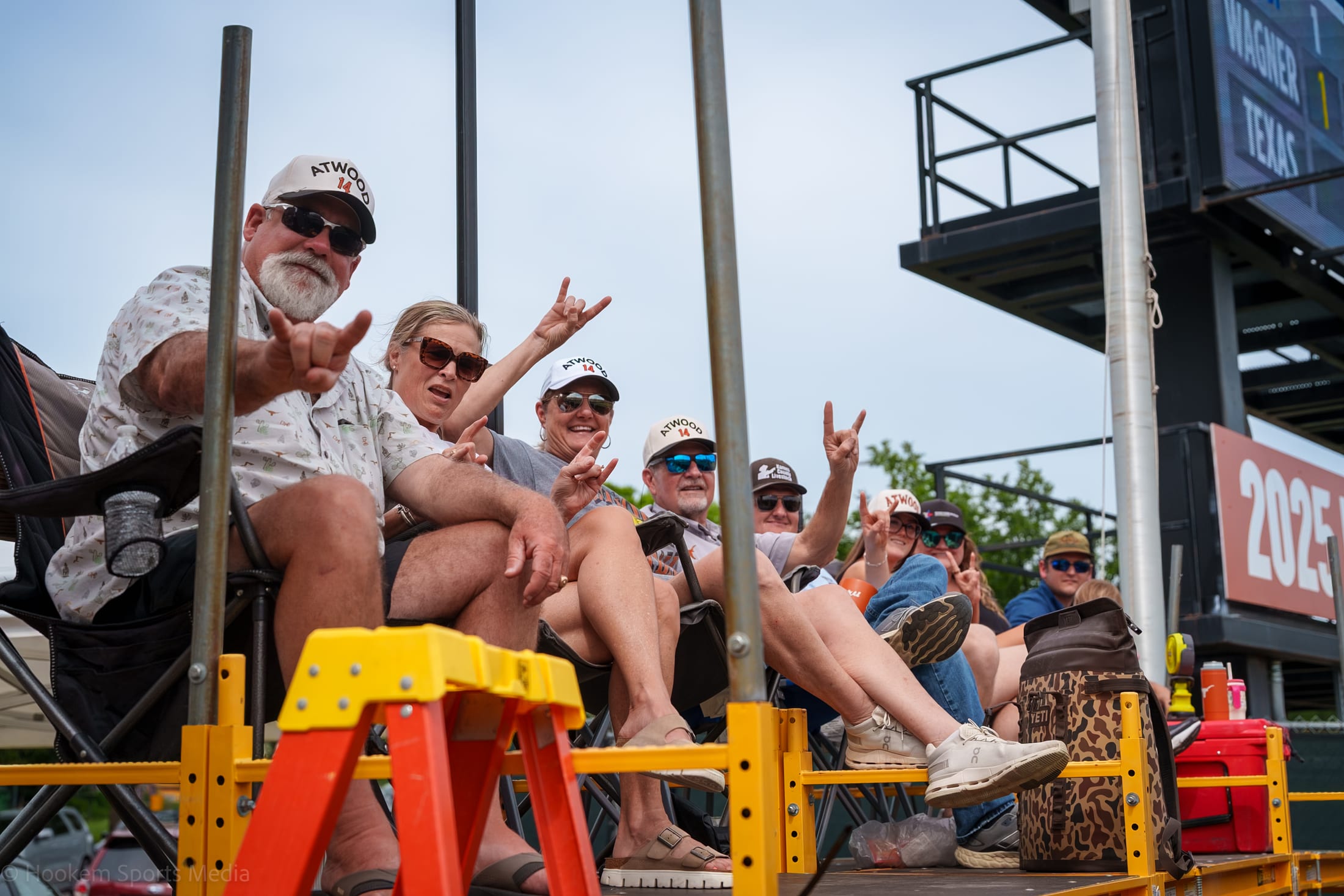
Geoff had been watching Reese play since she was seven. By 2024 - the year she chased history at the plate - he made a promise to himself: he was not going to miss a home game. Not one.
“So few athletes, so few parents, get to go down a journey like we have,” he said. “I didn’t want to miss it. I wanted to soak it all in because I truly knew we were on to something very special. I was going to make sure I was there if she needed anything.”
His seat moved with the stakes, and he eventually settled in the outfield because it gave him both views of Reese - her bat and her glove. When I first met him in the 2026 season, he was eager to see photographs of her framing a pitch the instant before the mitt closed, and just as eager for the balls she might drive his way.
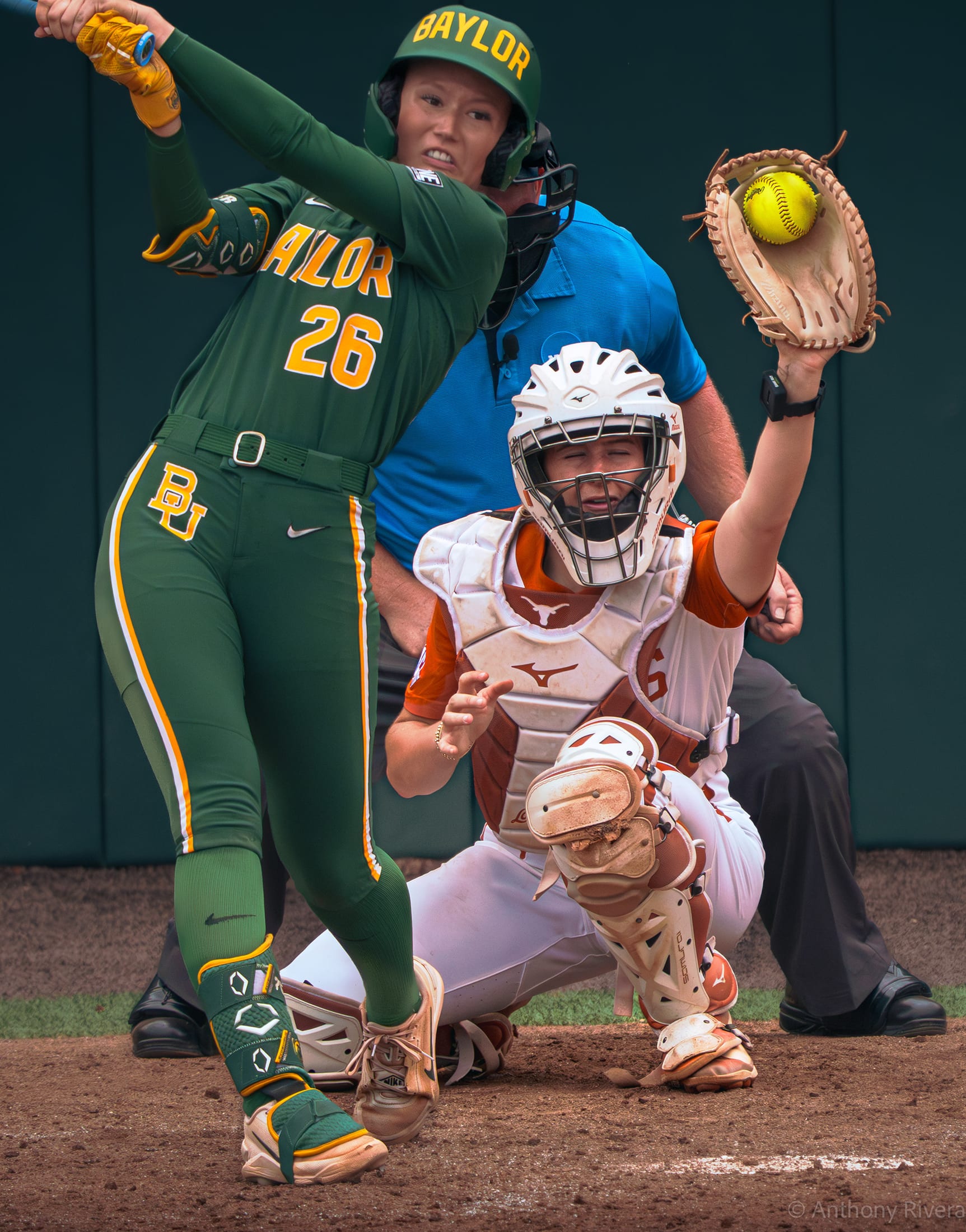
“I said, ‘Come on, Reese, I know you can do it - hit one at me,’” he recalled about the 2024 season. “She swings. The ball is heading right for me. I kind of froze. Then it comes down and hits me in the left foot.”
He kept the ball. His sister-in-law dove under the bleachers with a pack of kids to fight for it.
“Incredible feeling,” he said.
Karena and JT made the same kind of promise from Oklahoma City - three Women’s College World Series in three years. Karena had been to the WCWS before, as a player at Eastern New Mexico. Watching Kayden play for a championship there hit differently. “Going there three times and being in the championship three times is amazing,” she said. “I don’t know if you could draw out anything better than this - and then a back-to-back championship is awesome.” A freshman loss to OU. Then back-to-back national titles.
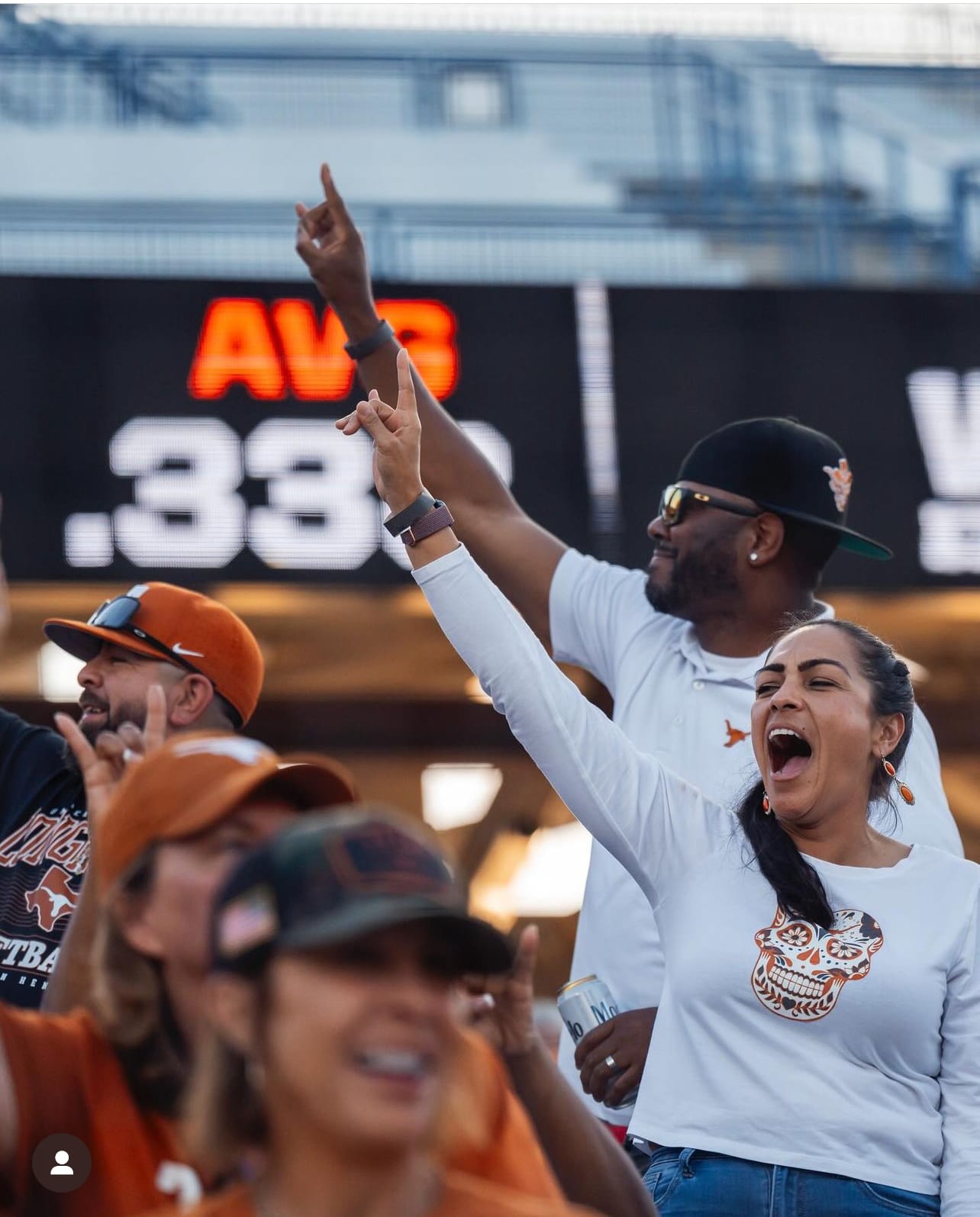
JT remembered the rematch most clearly: swept as a freshman, then beating the Sooners on their field with Kayden homering after telling her family, in effect, not this year.
“Even though we had lost so much to OU, at that time, she was still confident,” he said. “Nah - not this year.”
On camera Kayden kept the mood loose. After a two-run homer last season, she playfully told the broadcast her back hurt from “all this carrying” she was doing. JT smiled remembering it. “She tries not to let struggles show on her face,” he said. “She doesn’t want to play mad.”
What the cameras don’t catch
Showing up was only half of it. The other half was what parents did in the stands, on the concourse, and in hotel hallways when ESPN was not looking.
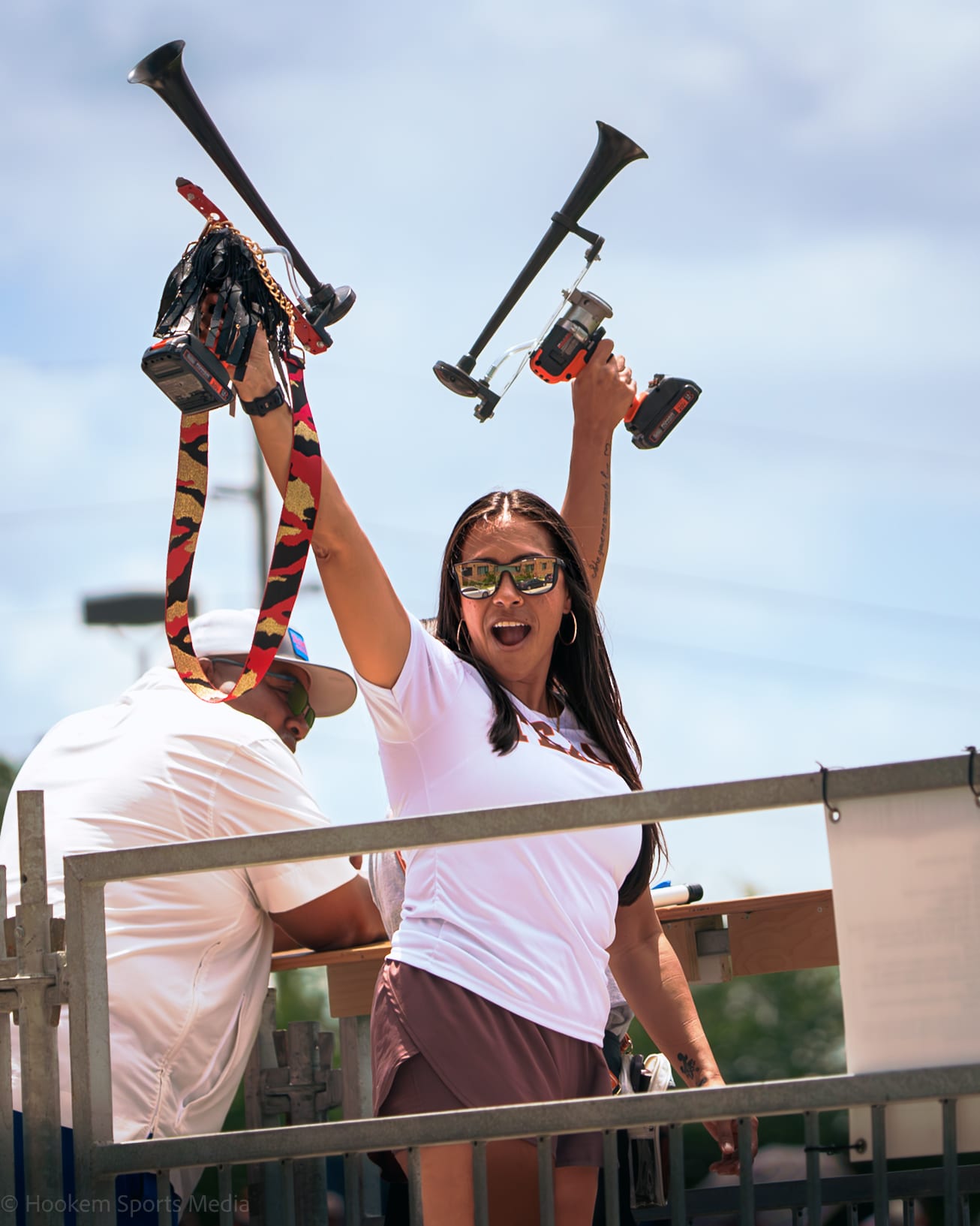
Karena described Texas softball parents as superstitious - assigned seats they do not actually sit in, husbands texting wives to stay put when the offense wakes up. During this year’s championship game, Karena rode the concourse with Viviana Martinez’s family: up when hits stalled, down to sit when they started falling, back upstairs when Viv’s mom refused to move after a rally because the inning was working.
“We’re a superstitious bunch,” she said. “That’s something the cameras don’t catch.”
Geoff recalled that Reese and Viviana Martinez were roommates at a hotel Reese believed was haunted. “They had some stuff going on inside their room,” Geoff said. Makeup and other things started falling off the bathroom counter in the middle of the night. “It freaked them out.” The players fled to another room and spent the night there.
Reese told him the next morning. “I got real worried,” Geoff said. He found Coach Singleton that afternoon. “Coach, you’re probably not going to believe this - but I’m worried Reese may not be getting a good night’s sleep. Obviously we were going into the championship here, and she really probably needs to be getting eight hours of sleep, and she’s not - and this is the reason why.” He told Singleton about the ghost. “It probably wouldn’t hurt if we tried to get her and Viviana into another room.”
Singleton said, “Oh my God - let me look into that.” He moved them both.
“That’s probably the off-camera piece I can tell you about,” Geoff said.
When you are not the one driving anymore
The chauffeur era ends before most people realize it - and neither parent is fully ready when it does.
Geoff said he had not been the chauffeur for the last four years of Reese’s college career. “University of Texas took over that role.” He missed only two of her college games her senior year. Pro ball meant five games a week across the country and honest limits - maybe five or six caught in person, the rest on TV, phone calls before and after. When we spoke, they had just driven back from Utah; Round Rock was next.
Reese signed with Carolina on June 7 - seventh overall in the AUSL college draft - and a week later homered twice off NiJaree Canady in Durham. Geoff and his wife sat just off home plate.
“You don’t know how she’s going to take on a new chapter when you flip that page from college to pro,” he said. “The biggest relief came the first time I saw her swing. I immediately knew she was comfortable. She wasn’t carrying extra weight from not knowing how stressful the professional world would be.”
Oddly, he is more relaxed at pro games now. Reese seems more relaxed too.
“We incredibly enjoyed Texas,” Geoff said. “For whatever reason, we’re just enjoying the games more now.”
Karena’s transition was harder in a different way. Kayden FaceTimes constantly, checks her mom’s location, asks what she’s doing and why she’s there.
“Dropping her off freshman year was super difficult,” Karena said. “I didn’t want to leave.” They adjusted to a long-distance rhythm - phone, text, FaceTime instead of seeing each other every day - and into something Karena calls an adult relationship. Kayden still asks how to make an appointment sometimes. She figures out plenty on her own, too.
Ask what they are proud of now, and none of them reach for a stat line.
Geoff goes first to the love of the sport itself - the thing no trophy case shows. “Her passion, her extreme desire to perform for her teammates, for her coaches, for herself. Five games a week right now as a professional. I don’t know how she does it. But she does.”
JT talks about the dugout leadership cameras miss - picking teammates up, keeping people laughing. Karena says Kayden is “just a good human” - if you are in her circle, she has your back, and her love language is gifts she puts real thought into.
Two Saturdays, same idea
This weekend put both families on the map at once - just not in the same ballpark.
Saturday, July 11, the Texas Volts host Reese Atwood and the Carolina Blaze at Dell Diamond for Family Day, presented by PECU. Geoff plans to be there. On the other side of the diamond will be Leighann Goode - Reese’s Texas teammate through two national titles, now in Volts purple. Geoff texts with Leighann’s father now and hopes both families can catch up off the field. Two daughters who won together in Austin, facing each other as pros in Round Rock. After Reese’s games, at the ballpark or walking into a restaurant, young kids still come up for autographs and pictures.
“That is an incredible feeling as a parent - to look over at your child and know she has that kind of fan base,” Geoff said. “I truly look forward to Saturday when fans and players get to intermingle - take pictures, sign autographs, cherish those moments.”
Family Day, to him, is not a promotion. It is the years on I-37 and the midnight returns from Conroe compressed into one afternoon - parents in the stands while the kid they drove everywhere plays for a living.
Kayden will be closer to home, having already committed to 713 Day in Alvin - a community softball tournament with a concert lineup that includes Slim Thug.
For Karena, the choice tracked back to how they raised her. “The community is huge,” she said - the village that carried Kayden when her parents could not, that taught her to show up with manners and maturity long before burnt orange. “She’s giving her word, and that’s what she’s gonna stick to,” Karena said. “We talk about giving back to the community all the time - how are you giving back? This is definitely one way.” Kayden was excited to be there. She wanted to come.
Same Saturday. Two ways of honoring the people who drove the miles.
What they would tell you
I asked each parent what a young softball family in Dickinson, Sandia, or anywhere else should remember.
JT talked about manners, grades, and giving back even on bad days - sign the autograph, take the picture, because that little girl was you once.
Karena offered the line she repeats when JT gets too competitive: “Don’t forget your young athlete is still young. It’s not that serious. We learn from the game and move on. Okay - it’s over. What do we learn?”
Geoff doesn’t dress it up: you show up, you keep driving, and you trust the work will add up to something.
The games change. The league changes. The kid grows up.
The parent in the parking lot - folding chair, homework in the back seat, coffee going cold, a text thread with another dad who’s been through it - is the constant this story is really about.
Kayden knew who the photo was for. Geoff still drives to Round Rock when he can. Different daughters. Same miles. Same hope that showing up first was worth it.
Anthony Rivera. Parent interviews conducted July 2026. Schedule and promotion details from AUSL and Round Rock event listings.